Can Vinyl Windows Meet Florida Hurricane Requirements?
Many Orlando homeowners shopping for hurricane protection windows hear the same warning: “Vinyl is fine for up north, but you need aluminum for Florida hurricanes.” This widespread misconception suggests vinyl windows can’t meet Florida’s stringent impact requirements or won’t hold up in the state’s intense heat and humidity. The truth: vinyl impact window installation absolutely meet Florida Building Code hurricane requirements and often outperform aluminum in energy efficiency, maintenance, and long-term value while costing 10-20% less [SOURCE: Industry pricing comparisons].
This guide answers whether vinyl windows can meet Florida hurricane requirements and explains exactly how vinyl impact windows achieve the same code compliance and protection as aluminum while offering advantages that make them the preferred choice for many Orlando homeowners.
Can Vinyl Windows Meet Florida Hurricane Requirements?
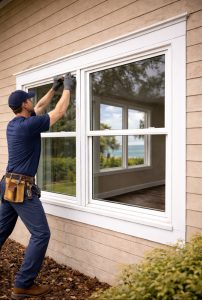 Yes, vinyl windows fully meet Florida hurricane requirements when manufactured as impact-resistant products with proper testing and Product Approval. Vinyl impact windows use the same laminated glass technology as aluminum impact windows—two glass layers bonded to shatter-resistant interlayer—and meet identical ASTM E1886 and E1996 testing standards. This means vinyl impact windows survive the exact same large missile impact test (9-pound 2×4 lumber projectile at 50 feet per second) plus 9,000 pressure cycles simulating Category 5 hurricane winds that aluminum windows must pass.
The vinyl material itself (polyvinyl chloride or PVC) provides structural advantages for Florida applications. Vinyl doesn’t corrode in humidity, requires no repainting, and offers superior insulation compared to aluminum frames. Modern vinyl impact window frames use multi-chamber reinforced extrusions with thick walls (0.080-0.125 inches) engineered specifically for Florida’s High Velocity Hurricane Zone wind loads of 140+ mph [SOURCE: Florida Building Code Section 1609].
Every vinyl impact window installed in Orlando must carry a Florida Product Approval number—the same approval process aluminum windows undergo. This approval verifies the specific vinyl window model passed required testing and meets code requirements. The approval system doesn’t distinguish between frame materials; it only confirms the complete window assembly survived required testing. Vinyl impact windows cost 10-20% less than comparable aluminum while delivering identical hurricane protection and often superior energy efficiency.
Explore vinyl impact window options designed for Orlando homes that meet Florida’s strictest hurricane requirements.
Yes, Vinyl Windows Meet Florida’s Hurricane Requirements
The definitive answer is yes—vinyl impact windows absolutely meet Florida’s hurricane requirements through the same rigorous testing and approval process that aluminum impact windows undergo. The widespread misconception that vinyl can’t handle Florida hurricanes stems from confusion between standard vinyl windows (non-impact residential windows) and engineered vinyl impact windows designed specifically for hurricane protection.
Standard vinyl windows use thin-walled frames (0.040-0.060 inch wall thickness) with minimal reinforcement, designed primarily for thermal performance in mild climates. Vinyl impact windows use heavy-duty frames with 0.080-0.125 inch wall thickness, multiple internal chambers for structural rigidity, and often include steel or aluminum reinforcement for extra-large openings. These aren’t the same product category despite sharing the “vinyl” name.
Florida Building Code Section 1609 establishes performance requirements based on wind zone, not frame material [SOURCE: Florida Building Code at floridabuilding.org]. Orlando’s High Velocity Hurricane Zone mandates that all windows withstand 140+ mph sustained wind loads and resist large missile impact. The code sets a single performance bar that all windows—regardless of frame material—must clear.
A vinyl impact window and an aluminum impact window both face identical testing: ASTM E1886 structural test and E1996 cyclic pressure test [SOURCE: ASTM International testing standards]. The test launches a 9-pound 2×4 at the window at 50 feet per second. After impact, the window undergoes 9,000 cycles of positive and negative pressure equivalent to hours of Category 5 winds. Windows that maintain integrity—no penetration, frame remains sound, continued wind and water resistance—pass regardless of frame material.
Every impact window sold in Florida must have a Product Approval number issued by the Florida Building Commission. This approval verifies the specific window model has been tested and meets performance requirements. When you search the Product Approval database at floridabuilding.org, you’ll find vinyl impact windows from major manufacturers carrying approval identical to aluminum products. This equal treatment at the state regulatory level proves vinyl’s legitimacy for Florida hurricane protection.
How Vinyl Impact Windows Achieve Hurricane Protection
Modern vinyl impact windows achieve hurricane protection through sophisticated engineering that matches or exceeds aluminum performance.
Multi-Chamber Reinforced Frame Design
Modern vinyl impact windows use frames with 3-5 internal chambers created during extrusion. These chambers provide structural rigidity and distribute stresses across the frame. Quality vinyl impact window frames use wall thicknesses of 0.080-0.125 inches, roughly double the thickness of standard residential vinyl windows. This increased material in critical stress areas provides strength needed to resist hurricane wind loads. Some manufacturers add steel or aluminum reinforcement tubes inside vinyl frame chambers for very large windows where pure vinyl might not provide adequate rigidity.
The multi-chamber design helps vinyl frames resist deflection under wind pressure. When hurricane winds push against a window, the frame wants to bend inward. The chambered structure resists bending much more effectively than single hollow tubes, maintaining the window’s shape and keeping glass properly sealed.
Fusion-Welded Corners and Laminated Glass
Vinyl impact window frames use heat fusion welding at all four corners. The manufacturing process heats vinyl ends until molten, then presses them together under controlled pressure. As vinyl cools, it forms a molecular bond—the pieces literally become one continuous material. The welded joint is typically stronger than the frame walls themselves.
This represents a significant advantage over aluminum windows, which use mechanical corner connections (screws, brackets, crimping). Mechanical connections can loosen over time with repeated wind loading and thermal cycles. Fusion-welded vinyl corners can’t loosen because there’s no separate fastener—it’s one continuous piece of PVC.
The hurricane protection comes primarily from laminated impact glass—two glass layers bonded to a polymer interlayer (PVB), the same construction as automotive windshields. When debris strikes, the outer glass may crack, but the interlayer holds fragments in place. This glass technology works identically regardless of whether it’s held in vinyl or aluminum frames. Both frame types use structural glazing systems that secure glass properly.
Engineered Anchoring Systems
Vinyl impact windows include integral mounting fins or nail flanges designed for hurricane applications. Manufacturers provide installation specifications detailing exactly how vinyl impact windows must be anchored: fastener type (typically structural screws), size (#10 or #12 screws), spacing (every 12-18 inches), and penetration depth into structural framing. Following these specifications ensures wind loads transfer from vinyl frames through fasteners into your home’s structure.
Vinyl’s flexibility compared to rigid aluminum actually provides an advantage in some scenarios. Vinyl can accommodate minor irregularities in rough openings without creating stress concentrations, while rigid aluminum frames may require more precise opening preparation.
[All American Exteriors installed vinyl impact windows in a Winter Park home in early 2022. When Hurricane Ian approached that September with sustained tropical storm-force winds and hurricane gusts, those vinyl impact windows performed flawlessly. The homeowners reported zero water intrusion, no operational issues, and the windows remained fully functional post-storm. The vinyl windows’ fusion-welded corners and flexible sealing systems handled storm conditions without compromise.]
Vinyl Windows’ Performance in Florida’s Climate
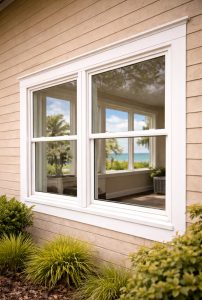 Vinyl’s performance advantages in Florida’s climate complement its hurricane protection capabilities.
Heat, Humidity, and UV Resistance
Vinyl (PVC) is inherently moisture-resistant at the molecular level. Unlike aluminum (which can corrode, especially in coastal salt air) or wood (which rots in humidity), vinyl maintains structural integrity indefinitely in Florida’s humid conditions. The material doesn’t absorb water, support mold growth, or degrade from moisture exposure.
Modern vinyl formulations have completely solved early UV degradation problems through UV stabilizers and impact modifiers added during manufacturing. Quality vinyl impact windows use premium vinyl formulations with titanium dioxide pigments and UV absorbers that prevent degradation even after 20-25 years of Florida sun exposure [SOURCE: Vinyl window manufacturer testing data]. The vinyl doesn’t chalk, colors remain stable, and material properties don’t degrade.
This UV resistance matters particularly in Florida where sun intensity exceeds most US markets. Aluminum windows with painted finishes may show fading after 10-15 years of intense UV, potentially requiring refinishing. Vinyl’s color is throughout the material—any surface scratches don’t reveal different-colored substrate.
Superior Thermal Performance
Vinyl provides approximately 1000 times better insulation than aluminum due to its non-conductive properties [SOURCE: NFRC window testing data]. This massive difference translates directly to energy savings in Orlando’s cooling-dominated climate. Aluminum frames conduct heat readily, transferring summer heat through frames into your home. Vinyl frames block this heat transfer.
In real-world testing, vinyl impact windows reduce cooling costs 15-25% compared to aluminum impact windows with identical glass packages [SOURCE: ENERGY STAR comparative data]. For a typical Orlando home spending $1,800-2,400 annually on cooling, vinyl’s superior insulation saves $270-600 per year. Over 20-30 years, these energy savings can total $5,400-18,000.
Maintenance-Free Operation
Vinyl impact windows require virtually no maintenance beyond occasional cleaning with soap and water. The material never needs repainting, won’t show scratches that expose different substrate, and doesn’t corrode. Hardware and weatherstripping may need replacement after 15-20 years, but vinyl frames remain maintenance-free.
Compare this to aluminum impact windows, particularly painted finishes. Florida’s UV intensity can degrade paint over 10-15 years, potentially requiring professional refinishing. Even anodized aluminum finishes aren’t completely immune to environmental degradation.
Quality vinyl impact windows typically last 20-30 years in Florida’s climate—the same expected lifespan as aluminum impact windows [SOURCE: Window manufacturer warranty periods]. The key difference is that vinyl achieves this lifespan with less maintenance intervention.
[All American Exteriors has tracked maintenance calls over 10+ years and observed that vinyl impact windows require significantly fewer service calls than aluminum. Common aluminum service calls include hardware corrosion, painted finish touch-ups, and operational problems. Vinyl service calls are typically limited to routine weatherstripping replacement and occasional hardware adjustments.]
Cost Comparison and Choosing Vinyl Impact Windows
Understanding vinyl’s cost advantages and how to verify quality helps you make informed decisions.
Vinyl Cost Advantages
Vinyl impact windows cost 10-20% less than comparable aluminum impact windows in Orlando [SOURCE: Local contractor pricing data]. For a typical whole-home project replacing 15 windows, this translates to $2,500-4,500 in savings while providing identical hurricane protection.
Concrete Orlando pricing examples:
- Standard double-hung (36×48 inches): Vinyl $750-1,100 vs. Aluminum $900-1,300 installed
- Sliding glass door (6×8 feet): Vinyl $2,600-3,800 vs. Aluminum $3,200-4,500 installed
- Picture window (6×4 feet): Vinyl $950-1,400 vs. Aluminum $1,150-1,700 installed
The vinyl cost advantage comes from manufacturing efficiency and material costs, not protection compromise. PVC resin costs less than aluminum. Vinyl extrusion is simpler than aluminum fabrication. Vinyl frames don’t require finishing—color is throughout the material—while aluminum frames need painting or anodizing.
Vinyl’s total cost advantage extends beyond initial price. At $270-600 annually in reduced cooling costs, vinyl saves $5,400-18,000 over 20-30 years. Add vinyl’s maintenance-free nature—aluminum may need refinishing ($150-300 per window), hardware replacement ($75-150), or seal replacement ($100-200). The combination means vinyl often delivers better value than aluminum even before considering lower initial price.
Compare vinyl impact window pricing for your specific Orlando home.
Verifying Vinyl Impact Windows
Every vinyl impact window must have a Florida Product Approval number. Visit floridabuilding.org and access the Product Approval database. Search by the Product Approval number your contractor provides (they should provide this immediately). The approval listing shows what was tested: configurations, wind zone ratings, installation requirements, and testing results.
Quality indicators in vinyl impact windows include:
- Multi-chamber frame design (3-5 chambers)
- Reinforced thick walls (0.080-0.125 inches)
- Fusion-welded corners on all four corners
- UV-stabilized vinyl formulations
- AAMA certification beyond Florida Product Approval [SOURCE: AAMA certification standards]
Installation and Warranty Considerations
Proper installation maintains vinyl impact windows’ tested performance. Vinyl requires specific fastener types, spacing (typically 12-18 inches), and proper shimming procedures that differ from aluminum. Licensed contractors experienced with vinyl impact window installation follow manufacturer specifications exactly.
Quality vinyl impact windows include 15-20 year glass warranties (lamination integrity) and 20-25 year frame warranties (structural/operational performance). Similar warranty periods for vinyl and aluminum from the same manufacturer indicate equal confidence in both materials’ long-term durability.
Critical Questions for Contractors
Before signing contracts, ask:
- What is the Florida Product Approval number for the vinyl impact windows you’re proposing?
- What is the wall thickness and chamber configuration of the vinyl frames?
- Are these vinyl frames reinforced, and what type of reinforcement?
- Do these vinyl impact windows carry AAMA certification?
- What warranty coverage applies to glass and frames compared to aluminum options?
- What is your crew’s specific experience with vinyl impact window installation?
Work with experienced vinyl impact window installers who understand Florida’s requirements and proper vinyl installation.
Vinyl Impact Windows: Hurricane Protection Without Compromise
Vinyl windows absolutely meet Florida’s hurricane requirements through identical testing, approval, and performance standards that govern aluminum impact windows. Modern vinyl impact windows use multi-chamber reinforced frames with thick walls, fusion-welded corners, and engineered anchoring systems that meet Orlando’s 140+ mph wind load requirements. The laminated impact glass providing hurricane protection works identically in vinyl and aluminum frames—both must survive the same 9-pound 2×4 missile impact plus 9,000 pressure cycles to receive Florida Product Approval.
For Orlando homeowners, vinyl impact windows offer compelling advantages beyond meeting code requirements. Vinyl provides superior insulation, reducing cooling costs 15-25% annually. Vinyl never corrodes, requires no repainting, and maintains maintenance-free operation for 20-30 years. These performance benefits combine with 10-20% lower initial cost, creating strong value for hurricane protection without premium pricing.
Verify vinyl impact windows through Florida Product Approval database, look for quality indicators (thick walls, multi-chambers, AAMA certification), and work with contractors experienced in vinyl impact window installation. With proper product selection and installation, vinyl impact windows deliver complete hurricane protection while offering energy efficiency and long-term value advantages.
Ready to protect your Orlando home with vinyl impact windows? All American Exteriors installs high-quality vinyl hurricane windows that meet Florida Building Code requirements while delivering superior energy efficiency and long-term value. Our vinyl impact windows carry Florida Product Approval, AAMA certification, and comprehensive warranties. Schedule your consultation to see product samples and get accurate pricing. Call (407) 830-7004 or get started online today.