Can Casement Windows Meet Florida Hurricane Requirements?
Many Orlando homeowners love casement windows—their unobstructed views, superior ventilation, and easy operation make them popular choices for kitchens, bathrooms, and living spaces. But when researching hurricane protection, homeowners often encounter concerning advice: “Casement windows have too many moving parts for hurricanes” or “You can’t get impact-resistant casement windows—stick with fixed windows.” This misconception suggests casement’s hinged operation and hardware create vulnerabilities that prevent them from meeting Florida’s stringent requirements. The reality: casement window installation absolutely meet Florida Building Code hurricane requirements when properly engineered as impact-resistant products, and their design offers specific advantages for Orlando homes.
This guide answers whether casement windows can meet Florida hurricane requirements and explains how impact-resistant casement windows deliver both the operational advantages you want and the code-compliant hurricane protection Florida mandates.
Can Casement Windows Meet Florida Hurricane Requirements?
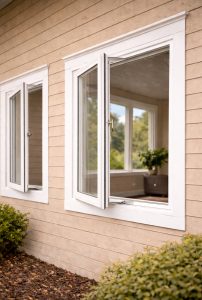 Yes, casement windows fully meet Florida hurricane requirements when manufactured as impact-resistant products with proper engineering, testing, and Product Approval. Impact-resistant casement windows use the same laminated glass technology as other impact window styles—two glass layers bonded to shatter-resistant interlayer—and meet identical ASTM E1886 and E1996 testing standards. They must survive a 9-pound 2×4 missile impact at 50 feet per second plus 9,000 cycles of positive and negative pressure simulating Category 5 hurricane winds [SOURCE: ASTM International testing standards].
The casement configuration—hinged on one side and opening outward—doesn’t compromise hurricane protection. Manufacturers engineer casement impact windows with reinforced frames, multi-point locking systems that secure the sash at multiple locations (typically 3-5 engagement points), and robust hinges designed for both daily operation and hurricane wind loads. When closed and locked, casement impact windows perform identically to fixed impact windows during storms. The multi-point locks create a rigid assembly where the sash compresses against the frame at multiple points, distributing wind loads effectively.
Each casement impact window must carry Florida Product Approval verifying it meets Orlando’s High Velocity Hurricane Zone requirements for 140+ mph winds [SOURCE: Florida Building Code Section 1609]. Casement style offers ventilation and view advantages—the entire window opening provides airflow compared to just 50% with sliding or double-hung windows—while providing complete code-compliant hurricane protection.
Explore casement impact windows designed for Orlando homes that deliver hurricane protection with superior ventilation.
Yes, Casement Windows Meet Florida’s Hurricane Requirements
The definitive answer is yes—casement impact windows absolutely meet Florida’s hurricane requirements through the same rigorous testing and approval process that fixed, double-hung, and sliding impact windows undergo.
The Casement Misconception
Many people assume casement windows’ hinged operation, hardware, and “moving parts” create vulnerabilities during hurricanes. This false belief suggests hinges might fail, locks might break, or the sash might blow open during extreme winds. These concerns confuse standard residential casement windows—which aren’t designed for hurricane protection—with engineered casement impact windows designed specifically to meet Florida’s stringent requirements.
Standard casement windows use light-duty hinges, single-point latches, and frames designed primarily for operation and basic weather resistance. Casement impact windows use completely different engineering: heavy-duty reinforced hinges, multi-point locking systems, reinforced frames and sash members, and laminated impact glass.
Casement Advantages in Hurricane Protection
When closed and locked, casement windows actually offer specific advantages. The multi-point locking system compresses weatherstripping at multiple locations around the sash perimeter, creating a superior seal compared to sliding windows that simply touch weatherstripping without compression. This compression seal performs exceptionally well against wind-driven rain during hurricanes.
Additionally, casement hinges can be positioned strategically. In Florida where prevailing hurricane winds come from the east and southeast, casement windows can be hinged on the side away from prevailing winds, positioning hinges on the compression side where wind pressure pushes the sash against the frame rather than trying to pry it open.
Same Testing Standards
Florida Building Code doesn’t have separate testing standards for different window styles. Casement impact windows undergo identical ASTM E1886 structural test and E1996 cyclic pressure test as fixed impact windows [SOURCE: ASTM International testing standards]. The test evaluates the complete window assembly—frame, sash, hinges, locks, weatherstripping, glass, and all hardware—in the closed and locked position.
The 9-pound 2×4 projectile strikes the window at 50 feet per second. After impact, the window undergoes 9,000 cycles of pressure equivalent to Category 5 winds. For the window to pass, the missile must not penetrate, the frame and sash must remain structurally sound, locks and hinges must continue functioning, and the window must resist wind and water infiltration.
Florida Product Approval Covers Casement
Search floridabuilding.org Product Approval database and you’ll find hundreds of approved casement impact window models from major manufacturers [SOURCE: Florida Product Approval database]. Each approval verifies that specific casement model passed required testing and meets code requirements. The approval documentation describes exact window configuration including casement style, number of locking points, hinge specifications, and installation requirements.
How Casement Impact Windows Achieve Hurricane Protection
Understanding that casement windows meet Florida’s requirements is the first step. Now let’s examine exactly how casement configuration is engineered to achieve hurricane protection.
Reinforced Frame and Multi-Point Locking
Casement impact windows use heavy-duty frames with significantly reinforced construction compared to standard casement windows. The frame uses reinforced corners, heavier wall thicknesses, and additional structural members designed to handle hurricane wind loads while supporting the sash weight.
The most critical difference is the locking system. Standard casement windows typically use a single-point lock—one handle engaging one latch. Casement impact windows use multi-point locking systems with 3-5 engagement points distributed along the sash perimeter. When you turn the lock handle, multiple locking points simultaneously engage at the top, middle, and bottom of the sash. These multiple engagement points distribute wind loads across the entire frame rather than concentrating force at one location.
This multi-point engagement also creates the weatherstripping compression that makes casement windows excel at water resistance. Each locking point pulls the sash tightly against the frame, compressing weatherstripping and creating a superior seal—particularly valuable during hurricanes when wind-driven rain tests every seam.
Engineered Heavy-Duty Hinges
Casement impact window hinges aren’t standard residential hardware—they’re engineered components designed for demanding dual purposes. Daily, these hinges must support the sash weight (heavier due to impact glass), provide smooth operation, and maintain proper alignment. During hurricanes, these hinges must resist extreme wind pressure.
Quality casement impact windows use hinges with reinforcement plates that distribute loads across larger areas of the frame and sash. Multiple heavy-duty fasteners secure each hinge—typically 4-6 screws per hinge driven into solid frame members. Hinge positioning also matters. Positioning hinges on the side away from prevailing storm winds creates favorable loading—wind pressure pushes the sash against the frame rather than trying to peel it away.
Laminated Glass and Weatherstripping Performance
The laminated impact glass in casement windows is identical to that in other impact window styles. Two glass layers are bonded to a polyvinyl butyral (PVB) interlayer creating glass that holds together when shattered. The casement configuration doesn’t change this glass technology.
The weatherstripping system receives particular attention because casement’s compression seal is a key advantage. Quality casement impact windows use multiple weatherstripping components: perimeter seals around the frame, compression bulb seals where sash meets frame, and sometimes additional seals at corners. When the multi-point lock engages, it compresses all these seals simultaneously, creating exceptional resistance to wind and water infiltration.
[All American Exteriors installs casement impact windows from manufacturers who engineer every component—frames, sash, hinges, locks, and weatherstripping—as an integrated system for hurricane protection. We demonstrate multi-point locking operation during consultations so homeowners understand how casement impact windows achieve their superior seal and structural performance.]
Casement Operation and Hurricane Performance
Let’s address specific concerns about casement operation during hurricanes and show how operational advantages don’t compromise protection.
Closed and Locked Casement Equals Fixed Window
When a casement impact window is closed and the multi-point lock is fully engaged, the sash becomes essentially a fixed panel compressed against the frame. The hinges and multiple locking points create a rigid assembly where the sash cannot move relative to the frame. In this closed and locked position, the casement window performs identically to a fixed impact window during hurricanes.
Wind pressure doesn’t know or care whether a window could theoretically open when evaluating a closed and locked unit. ASTM testing evaluates casement windows in their closed and locked position—the configuration they’ll be in during any hurricane. Casement’s operational capability is completely separate from its hurricane performance.
Hardware Undergoes Complete Testing
ASTM testing evaluates the complete casement window assembly including all hardware components. If locks broke during the 9,000 pressure cycles, if hinges pulled free from the frame, if weatherstripping seals failed, the window would fail testing and not receive Product Approval. Approved casement impact windows have proven that their hardware—not just their glass—withstands Category 5 hurricane conditions.
Superior Ventilation Without Protection Compromise
Casement windows provide superior ventilation compared to double-hung or sliding windows. When fully opened, a casement window provides 100% of the window opening for airflow. A double-hung or sliding window only opens 50%. This ventilation difference matters in Orlando’s climate.
During mild weather (October-April), natural ventilation can reduce air conditioning loads significantly. Opening casement windows to capture breezes means less AC runtime and lower electricity costs. You get this year-round operational advantage while maintaining identical hurricane protection to non-ventilating fixed windows.
No Storm Preparation Required
Like all impact windows, casement impact windows require zero storm preparation. When hurricane warnings issue, homeowners simply close and lock casement windows exactly as they would when leaving home. No panels to install, no shutters to deploy, no special procedures beyond normal close-and-lock operation.
[All American Exteriors installed casement impact windows throughout an Orlando home before Hurricane Ian. The homeowners closed and locked their casement windows in less than 5 minutes. Despite sustained tropical storm-force winds and hurricane gusts, every casement impact window performed flawlessly with zero water intrusion and the multi-point locks remaining engaged throughout the storm.]
Casement Impact Windows and Florida Building Code
Understanding code compliance and insurance benefits eliminates any regulatory concerns about casement configuration.
Performance Standards Apply Equally
Florida Building Code Section 1609 establishes performance requirements for windows based on wind zone—not window style [SOURCE: Florida Building Code at floridabuilding.org]. The code requires windows in Orlando’s High Velocity Hurricane Zone to withstand 140+ mph sustained wind loads and resist large missile impact. It doesn’t distinguish between casement, double-hung, sliding, or fixed windows—all face identical requirements.
This performance-based approach means the code evaluates what windows can withstand, not how they’re constructed or whether they can open. Casement’s hinged operation is irrelevant from a code compliance perspective—only the window’s performance in testing matters.
Product Approval Tests Complete Assembly
When casement impact windows undergo testing for Florida Product Approval, the complete window is tested as an integrated assembly including frame, sash, hinges, multi-point locks, weatherstripping, glass, and all hardware. The approval doesn’t just verify the glass can survive impact—it confirms the entire casement window assembly including its operational components performs under hurricane conditions.
Insurance Discounts Apply to Casement
Florida insurers provide premium discounts—typically 10-20% on wind coverage—for homes with approved impact windows [SOURCE: Florida Office of Insurance Regulation]. These discounts apply to all impact window styles including casement when properly approved and installed. Insurance companies base discounts on verified hurricane protection capability, not window configuration. The insurance industry’s recognition of casement impact windows provides additional validation beyond building code compliance.
Choosing and Installing Casement Impact Windows in Orlando
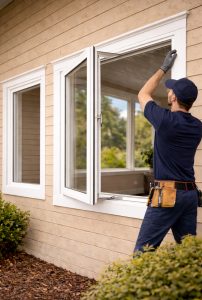 Understanding how to choose quality casement impact windows and ensure proper installation ensures you get the protection and performance you’re paying for.
Product Approval Verification
Request the Florida Product Approval number for specific casement impact windows your contractor proposes. Visit floridabuilding.org and search the database. Verify that approval specifically covers casement configuration—don’t assume a manufacturer’s “impact window approval” automatically includes all their window styles.
Quality Indicators
Look for these features indicating quality casement impact construction:
Multi-point locking system with minimum 3-5 engagement points distributed around sash perimeter. The lock should engage smoothly and create visible compression of weatherstripping.
Heavy-duty hinges with reinforcement plates distributing loads across frame and sash. Quality hinges include multiple fasteners (4-6 screws per hinge) and should support the sash smoothly without sagging.
Reinforced corners using fusion-welded construction (vinyl) or mechanically reinforced joints (aluminum). Corners represent critical stress points.
Proper weatherstripping compression visible when window is locked. You should see the sash compress against weatherstripping at all locking points.
Smooth operation indicating quality construction, proper balance, and correct installation.
Installation Considerations
Casement impact windows have specific installation requirements:
Proper shimming and squaring ensure the frame is perfectly plumb, level, and square. Even minor misalignment can cause binding or gaps that compromise the seal.
Correct weatherstripping compression must be achieved through proper installation and lock adjustment. Too much compression makes operation difficult; too little compromises the seal.
Hinge reinforcement requires anchoring to solid structural framing. Hinges carry significant loads—both sash weight and hurricane wind forces.
Verify your contractor has experience specifically with casement impact window installation, not just general impact window experience.
Cost and Value
Casement impact windows typically cost similar to double-hung impact windows—roughly 10-20% more than fixed impact windows of similar size [SOURCE: Local Orlando contractor pricing]. The cost premium reflects additional engineering (hinges, locks, operational mechanisms) and more complex installation.
For Orlando homes, casement’s ventilation advantage provides year-round value beyond hurricane protection. Natural ventilation during mild weather can reduce air conditioning loads while providing comfort improvements.
Critical Questions for Contractors
Before signing contracts:
- What is the Florida Product Approval number for the casement impact windows you’re proposing?
- How many locking points does the multi-point locking system have?
- What is the hinge load rating and reinforcement design?
- What weatherstripping compression measurement does this casement achieve when locked?
- What is your crew’s specific experience with casement impact windows?
- What warranty covers hinges, locks, and operation mechanisms?
Work with experienced casement impact window installers who understand both hurricane protection requirements and casement operational considerations.
Casement Impact Windows: Protection with Superior Ventilation
Casement windows absolutely meet Florida’s hurricane requirements through identical testing, approval, and performance standards that govern all impact window styles. When manufactured as impact-resistant products with proper engineering, casement windows deliver complete code-compliant hurricane protection while offering operational advantages that fixed windows cannot provide.
Modern casement impact windows combine reinforced frames, multi-point locking systems, heavy-duty hinges, and laminated impact glass into integrated assemblies engineered specifically for Florida’s High Velocity Hurricane Zone. When closed and locked, casement windows perform identically to fixed windows during hurricanes—the hinged operation and hardware are designed to withstand Category 5 conditions.
For Orlando homeowners, casement impact windows provide compelling advantages beyond meeting mandatory hurricane protection requirements. The superior ventilation casement windows offer—100% of the opening provides airflow compared to 50% with sliding or double-hung styles—delivers year-round comfort and potential energy savings. The compression seal created by multi-point locking systems often outperforms sliding window seals in water infiltration resistance.
Verify casement impact windows through Florida Product Approval database, look for quality indicators including 3-5 point locking systems and reinforced hinges, and work with contractors experienced specifically in casement impact installation. With proper product selection and installation, casement impact windows deliver complete hurricane protection while providing ventilation and operational advantages that make them an excellent choice for Orlando homes.
Ready to protect your Orlando home with casement impact windows? All American Exteriors installs hurricane-rated casement windows that meet Florida Building Code requirements while providing superior ventilation and unobstructed views. Our casement impact windows feature multi-point locking systems, heavy-duty hinges, and laminated impact glass for complete storm protection with the operational advantages casement windows offer. Schedule your consultation to see casement options and get accurate pricing. Call (407) 830-7004 or get started online today.